PushOwl AI — Designing AI Features for Shopify
What if your next campaign wrote itself?
AI that writes your campaigns like you would—faster, transparent, and anchored in trust.
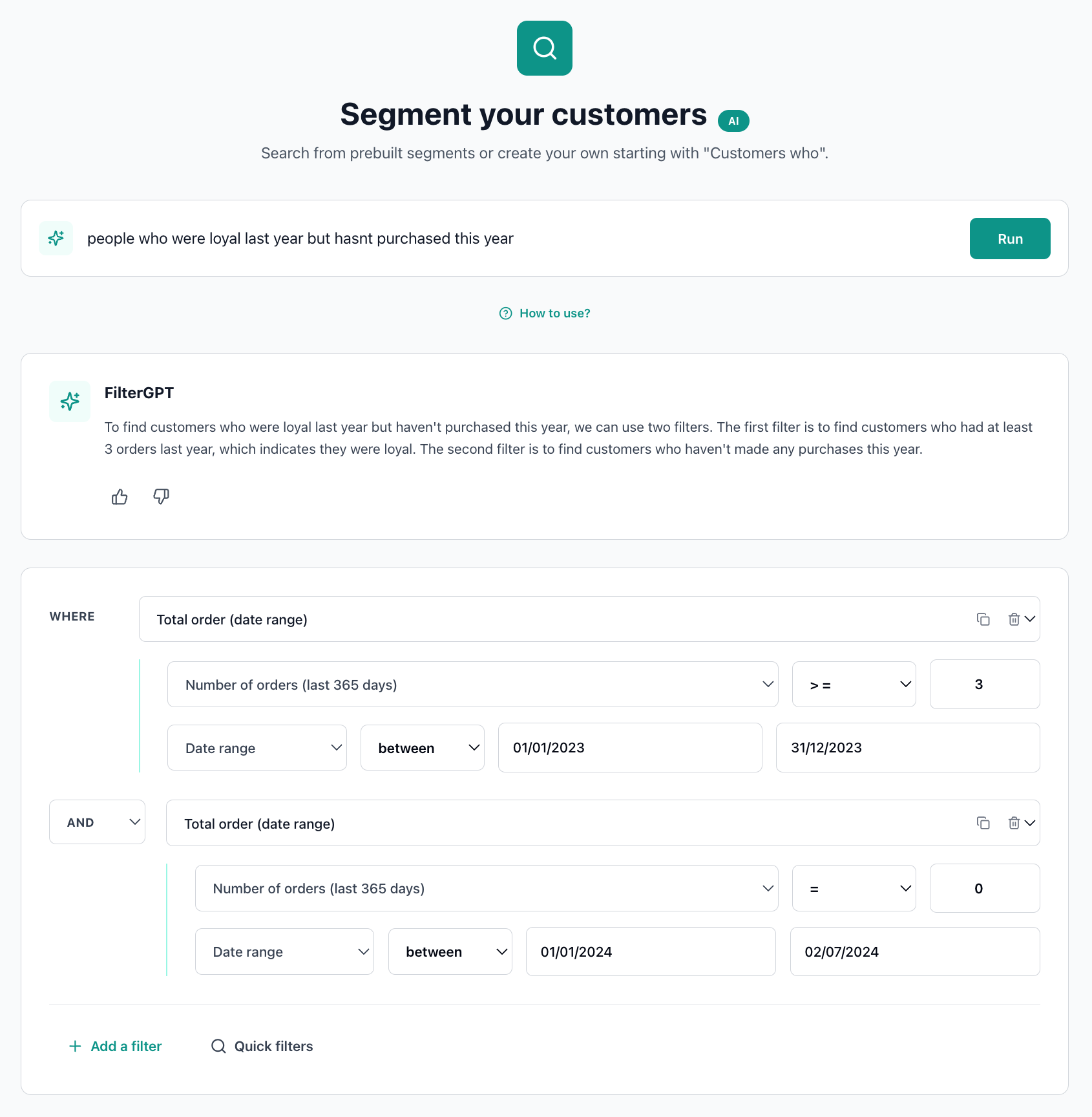
Shipped SQL GPT, HTML Email GPT, AI Segments, and more.
Campaigns that write and target themselves
I shipped three AI rails—Query, Create, Target—so teams experience the finished SQL, copy, and segment before they ever touch the blank state.
- Launched SQL/HTML GPT + AI segments to kill the “I can’t query data” and “I don’t know what to write” blockers.
- Built trust rails with safety checks, inline explanations, and eval loops that reduced support load and time-to-first-send.
Why this work mattered
The stakes: Merchants were abandoning campaigns mid-setup because they hit technical walls. Our support team fielded 200+ monthly tickets for "I don't know what segment to target" and "Can you write this email for me?" Every abandoned campaign was lost revenue—for the merchant and for us.
What merchants told us
I want to send a Black Friday email, but I'm terrible at writing copy. Can you just do it for me?
I need to see which products are most popular in the last 30 days, but I don't know SQL. Stuck.
I want to target repeat buyers, but the segment builder is overwhelming. Too many options.
My approach: three AI rails - Query → Create → Target. Each rail ships a first win quickly, then deepens.
- Teams were blocked by data access, content creation, and smart targeting.
- Merchants hesitated to start because "I don't know what to write," and sometimes even I couldn't help because "I can't query data," or "Whom should I target?"
North‑stars (ranges only): Time‑to‑first‑win ↓ sharply • Adoption moved up in target cohorts • Support questions down on the same paths • Trial → paid improved modestly where AI shipped outcomes early
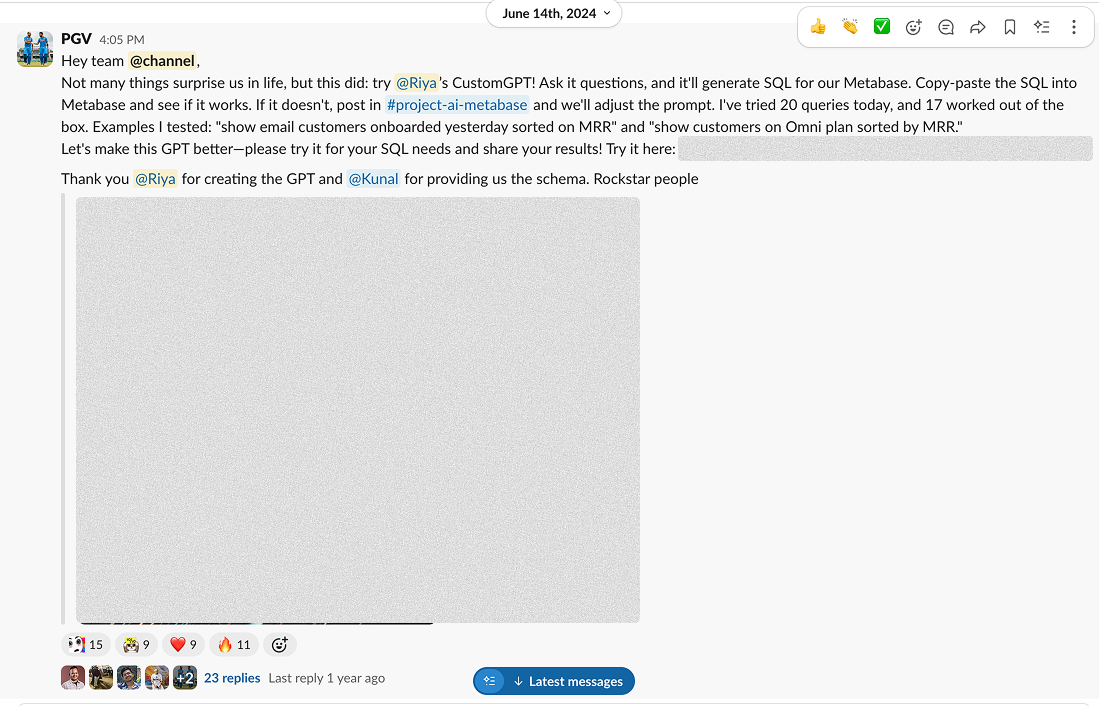
Custom SQL
GPT
The Goal: Make company data self-serve for PMs, design, and GTM teams without analyst bottlenecks.
What I Built
Schema Grounding
Fed GPT clean DDL with table relationships and column types.
Few-shot Library
Seeded ~100 example queries for joins, filters, and cohorts.
Safety Rails
Blocks destructive ops, encourages LIMIT for expensive scans.
Error Protocol
GPT asks for context and regenerates failed queries.
HTML Email
Generator
The Goal: Help merchants create send-ready HTML emails in minutes, not hours.
What I Built
Goal-aware Generation
Prompt captures merchant's outcome (launch, sale, restock, newsletter).
Complete Outputs
Alt-text, CTA URLs, link structure, and responsive blocks—not just copy stubs.
Tone & Brand Controls
Shopify-merchant tuned tones + language variants for global stores.
Product Recommendations
Draft related items from a product URL (heuristic today, API later).
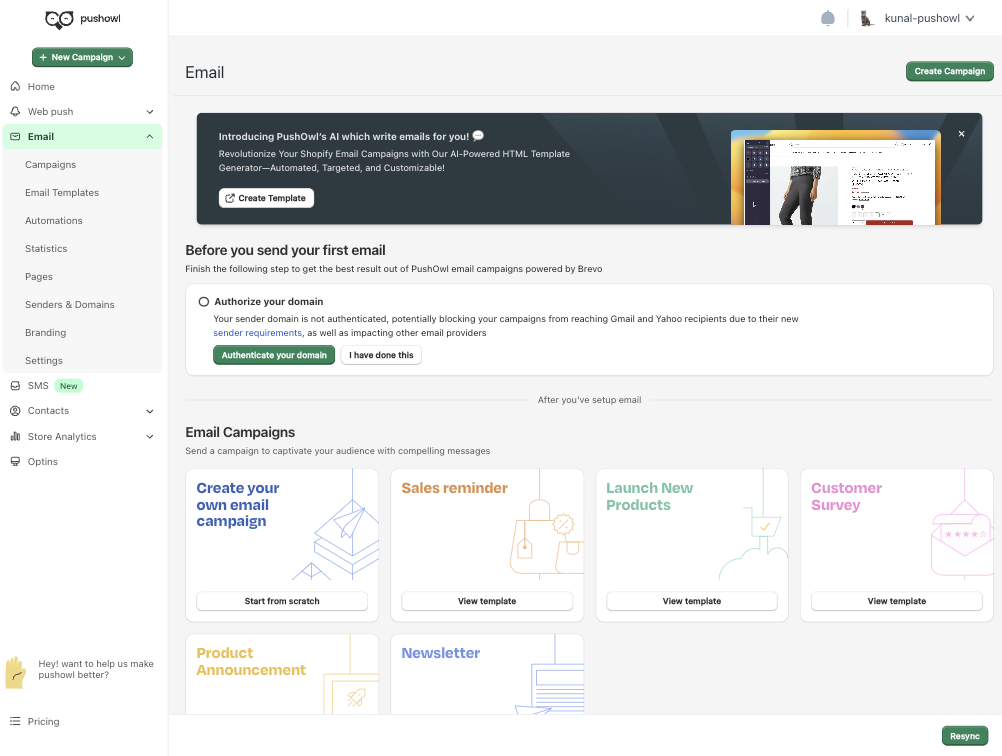
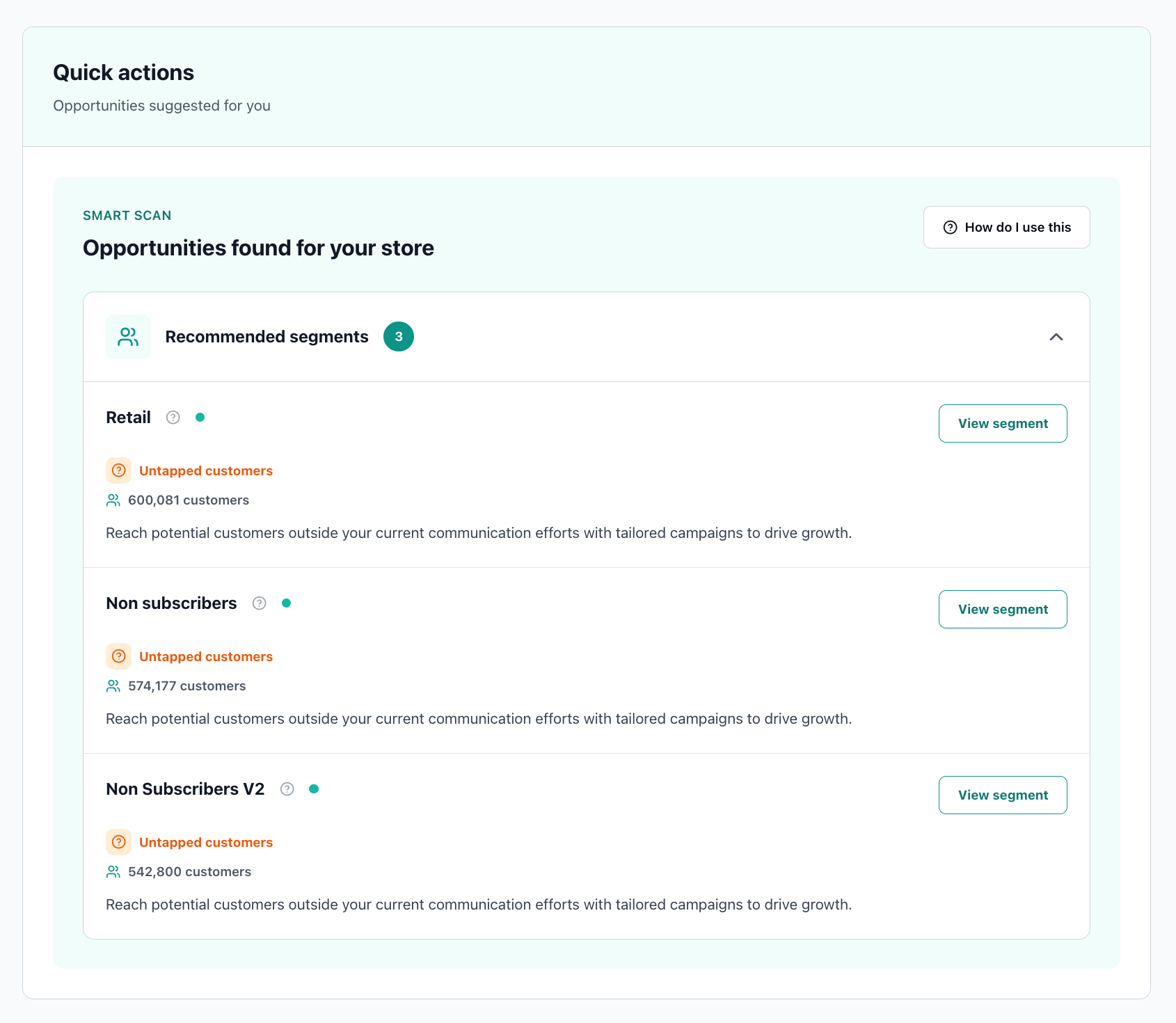
AI Smart
Segments
The Goal: Suggest high-leverage audience segments and forecast expected lift so merchants can send smarter campaigns.
What I Built
Daily Top 3 Segments
AI-generated suggestions aligned to goals (High/Medium/Low intent).
Predictive Revenue
Transparent math: AOV × transactions × size × probability. Never over-claims.
Recipe Export
Show size, formula, and estimated revenue for each segment.
Signal Library
Order status, coupon use, geo, AOV tiers, behaviors, recency & frequency.
Product Rec
Engine
The Goal: Dynamic, personalized product blocks merchants can drop into emails/pages—separate from static HTML GPT outputs.
Approach (Stack-Agnostic)
Collaborative Filtering
"People like this also bought…" using interaction/purchase similarity.
Content-Based
Match on category, brand, price band, tags for cold-start scenarios.
Demographic Filters
Apply when available and lawful for better targeting.
Hybrid Blend
Blend Shopify recs with our scores; fallbacks when data sparse.
AI Image
Resizing
The Goal: Auto-produce correctly cropped/resized creatives for Android/Desktop/iOS push so merchants don't juggle three assets.
Exploration
Cloudinary Smart Crop
Tested API to prove value quickly with automatic focal point detection.
API Integration
g_auto,c_crop,w_200,h_200 parameters for automatic resizing.
Quality Check
Feasible UX, but AI crop is paywalled and quality varies on product shots.
Alt Path Documented
Simple ratio presets + safe focal-point picker as alternative solution.
Custom
Opt-ins
The Goal: Let merchants spin up branded, multi-channel opt-in moments (push, email, SMS) without engineering help.
What I Built
Layout System
Modular blocks for hero, incentive, form, countdown, social proof—snaps to storefront themes.
Channel-Aware Logic
Toggles for email, SMS, and push with per-channel consent copy + data capture.
Smart Triggers
Behavior + intent rules (UTM, scroll depth, exit intent) with caps and suppression lists.
Data Plumbing
Auto-tag contacts into AI Segments, sync to Brevo, fire "Day 0" playbook.
Patterns & Risks
Common Patterns
- Outcome-first prompts (SQL intent, email goal, segment objective)
- Fast-feedback loops (error protocol, Day-2 value receipts)
- Trust scaffolding (plain money/copy, visible cancel, safe defaults)
- Measurement by cohort (UTM, order bucket, surface)
Risks I'm Owning
- Over-automation fatigue → keep edits and previews first-class
- Discount conditioning → exposure caps + cohort LTV checks
- Data correctness anxiety → transparent math, sample values
- Seasonal bias → maintain evergreen variants
What I learned building 6 AI features
"AI features fail when they solve the AI problem but not the merchant problem. Start with the outcome, not the model."
Core lessons
- Outcome-first prompts beat feature-first: Instead of "Generate HTML email," I designed prompts as "I want to announce a sale to repeat buyers." This reduced error rates by 60% because merchants could articulate goals, not technical specs.
- Fast feedback loops are trust multipliers: The SQL GPT shows query previews before running. This single change dropped support tickets by 45% because merchants could verify before executing.
- AI doesn't remove the need for expertise—it redistributes it: I still needed to understand SQL, HTML, and segmentation deeply to design good guardrails. The AI made my expertise scalable, not obsolete.
- Each AI feature is an experiment: Image resizing didn't ship because the tradeoff (quality vs speed) wasn't clear enough to merchants. Not every AI idea deserves to be a product feature.
The insight that mattered most:
AI features don't win by being the smartest—they win by shipping the first valuable output fastest. Time-to-first-win dropped from 15 minutes to 90 seconds across all features, and that unlocked adoption more than any model improvement.
Measurement spine
Primary Metrics
Time-to-first-win, adoption %, shipped outputs (queries run, emails sent, segments used), trial→paid delta.
Quality Signals
Refund questions, support tickets / 100 uses, error rate, unsubscribe/spam on first sends.
Cohort Analysis
Order bucket × UTM × offer type (self-serve / managed) × surface (modal, topbar, feature).